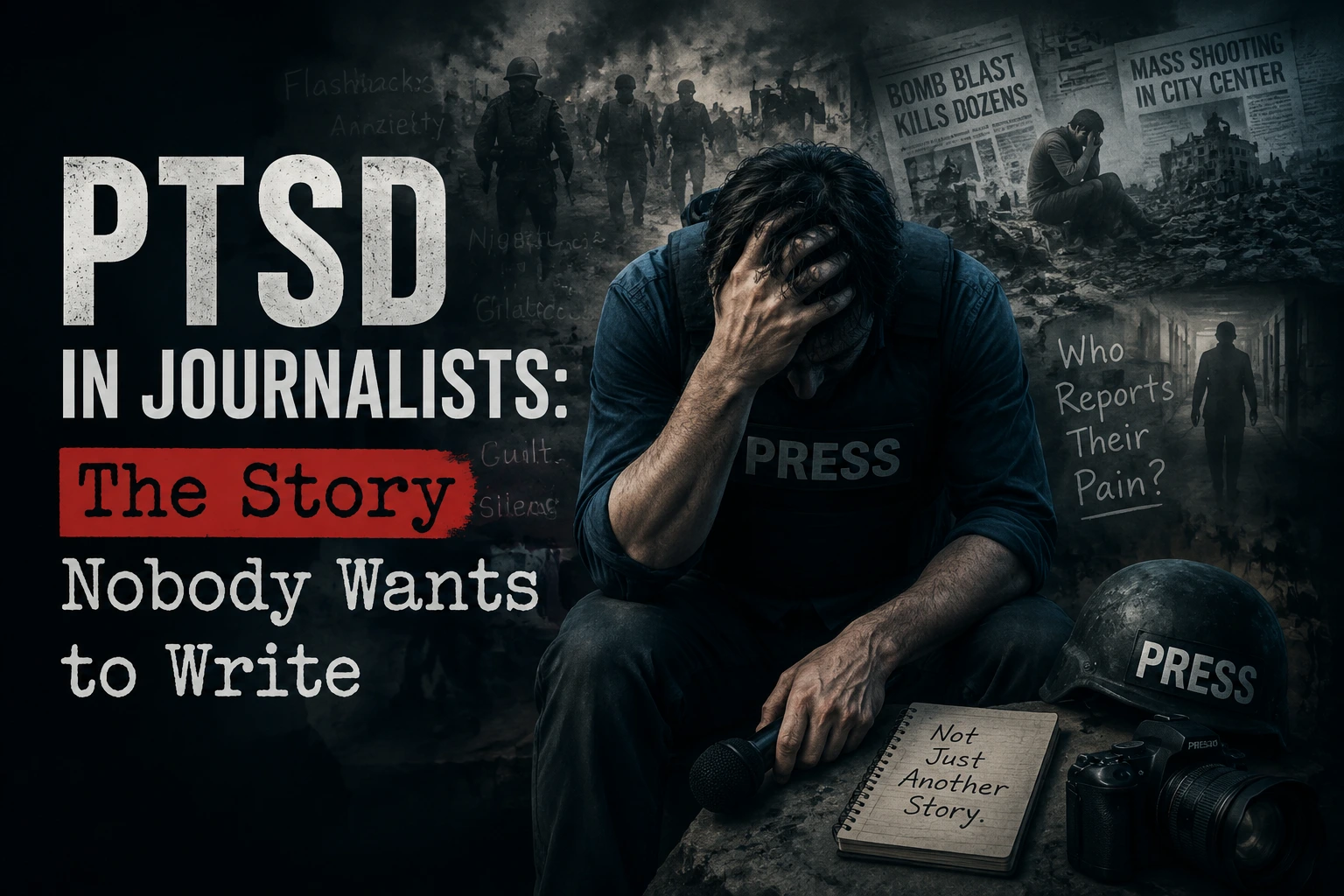
Journalists routinely ask challenging questions as part of their profession.
They question politicians regarding corruption, inquire with families about loss, and prompt survivors to revisit experiences that most individuals would prefer to forget.
However, there remains a question that many journalists seldom address:
What are the psychological and emotional impacts of this profession?
This subject rarely appears in mainstream headlines. Audiences typically encounter the completed article, documentary, or breaking news segment, but seldom witness the aftermath once the cameras are packed away and the assignment concludes.
This lack of discussion contributes to the persistent neglect of PTSD among journalists, even though many reporters spend years covering war, violence, disasters, human trafficking, and crime.
Jeff McCoy discusses this reality through the character Bobby Wallace in Finding Bobby. Bobby, an experienced journalist, has spent years reporting from hazardous environments. The significance of his story lies not only in what he witnessed but also in the enduring effects that persist after his return home.
The Prevailing Newsroom Culture of Moving Forward
Journalistic practice is fundamentally structured around strict deadlines.
One story ends. Another begins.
Reporters are frequently expected to process challenging events rapidly and transition immediately to subsequent assignments. There is often insufficient time to reflect on or discuss these experiences.
Consider the experience of spending several days interviewing victims of violence or documenting the aftermath of a tragedy, followed by the expectation to begin a new assignment within hours.
For many journalists, this rapid transition becomes routine. However, these experiences do not necessarily dissipate once the assignment concludes.
The Enduring Impact of Certain Stories
Not every assignment has a lasting psychological impact on the reporter.
Some assignments, however, do have enduring effects.
These may involve a child affected by conflict, a family seeking resolution, or a victim whose case remains unsolved. Years later, details from such stories can resurface unexpectedly. This aspect is often overlooked by readers when engaging with news content.
Journalists receive training to observe, document, and maintain professionalism.
They’re still human.
Prolonged exposure to traumatic events can make it increasingly difficult for reporters to distinguish between professional responsibilities and personal life.
The Unexpected Challenges of Reporting on Domestic Crime
It is commonly assumed that journalists returning from war zones would find reporting on local crime less challenging.
In some cases, the opposite proves true.
Domestic crime stories often feel more immediate; the locations are familiar, and the victims may resemble acquaintances. The psychological distance present during foreign assignments is diminished.
A reporter covering a missing-person case in their own community may experience a different level of emotional engagement than when reporting on distant conflicts.
This concept recurs throughout Finding Bobby.
Bobby is not merely investigating new crimes; he brings years of accumulated experience to each decision. Consequently, the narrative focuses as much on the investigator as on the investigation.
PTSD Doesn’t Always Look Like People Expect
The term PTSD often evokes images of dramatic portrayals commonly depicted in films.
In reality, the manifestations are typically more subtle.
Sometimes it looks like avoiding certain conversations.
Sometimes it looks like sleepless nights.
Sometimes it looks like throwing yourself deeper into work because slowing down means facing memories you’ve spent years avoiding.
Many journalists maintain professional performance while privately contending with experiences that are not fully understood by those around them.
This dynamic contributes to the prolonged lack of recognition of PTSD within the field of journalism.
The symptoms are not always externally observable.
Why Journalists Rarely Write About It
Another factor contributes to the limited attention this topic receives. Journalists are accustomed to occupying the role of observer.
Conventionally, the narrative is expected to focus on others rather than the journalist.
Discussing personal challenges can be uncomfortable, particularly in a profession that prioritizes objectivity and resilience. Some reporters are concerned about potential impacts on professional reputation, while others may lack the language to articulate experiences they have long attempted to compartmentalize.
Consequently, discussions regarding trauma often occur privately, if they occur at all.
What Finding Bobby Gets Right
A notable strength of Finding Bobby is its refusal to treat trauma merely as a narrative device. Bobby Wallace is not defined by PTSD, but rather by his responses to it.
He continues to seek answers, pursue stories, and attempt to make sense of events that persist in his memory. This characterization enhances his credibility as a realistic figure.
Readers are more likely to relate to characters who grapple with adversity while striving to progress, rather than to idealized heroes.
For journalists, certain stories do not conclude upon publication.
After the deadline passes and the article is published, readers proceed to other news. However, the journalist who reported the story may continue to carry the psychological impact for years.
This aspect of journalism remains largely invisible to the public.