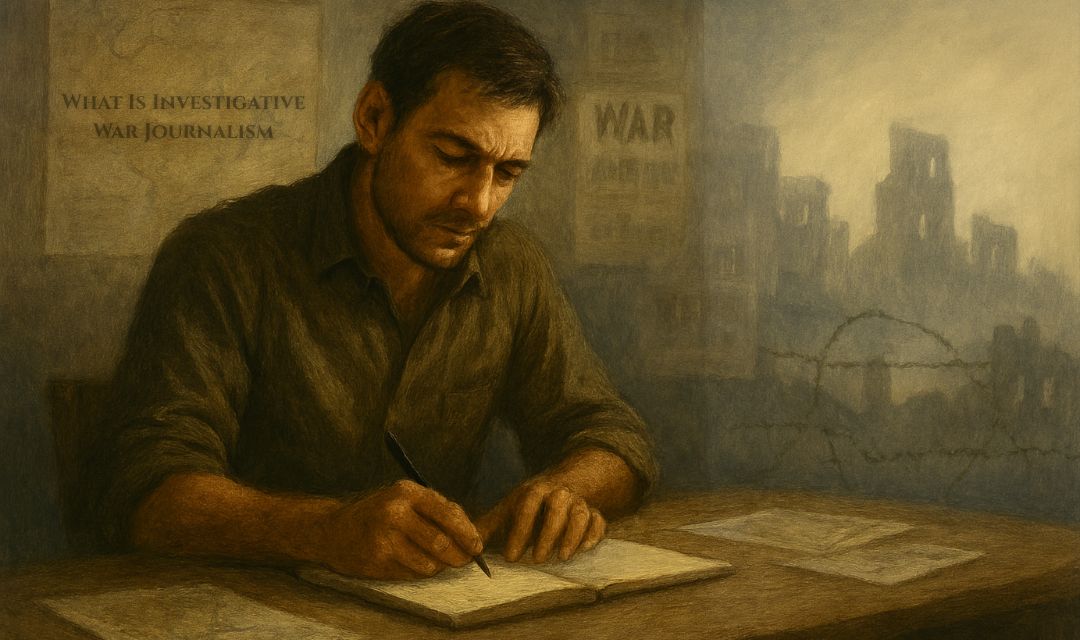
People often misunderstand investigative war journalism. Some think it is just war reporting in riskier places or with more dramatic stories. In fact, it is a different kind of work with its own purpose, pace, and risks.
Investigative war journalism uncovers what is hidden during conflict. It goes beyond official statements, battlefield updates, and daily headlines. The aim is not to be fast, but to understand. This difference is especially important today, when information is often controlled and used as a tool.
With this in mind, it is important to explain what investigative war journalism is and how it stands apart from other types of reporting.
What Investigative War Journalism Actually Means
Investigative war journalism focuses on long-term, in-depth reporting from conflict zones. Instead of documenting what happened today, it asks harder questions about why things are happening at all and who benefits from them.
This kind of work often involves tracing decisions made far from the front lines, examining patterns rather than isolated incidents, listening to voices that are usually ignored, and verifying claims that are repeated but rarely questioned.
Unlike daily war reporting, investigative work does not depend only on short visits or official briefings. It takes time, trust, and a willingness to follow difficult leads. This process is slow and uncertain, and it often encounters resistance from those in power.
In simple terms, investigative war journalism is less about witnessing events and more about exposing systems.
How Investigative War Journalism Is Different from Daily War Reporting
Daily war reporting plays an important role. It tells people what is happening right now. It provides updates, context, and immediate visibility during fast-moving situations. Investigative war journalism serves a different function.
The differences are not about skill level or courage. They are about intent.
Daily reporting tends to focus on immediate developments, official statements, and visible consequences of conflict. Investigative war journalism focuses on hidden causes and long-term impact, contradictions between public narratives and reality, and decisions that affect civilians but remain unexamined.
Another key difference is accountability. Investigative war journalism is not satisfied with surface explanations. It looks for responsibility. That can involve governments, military structures, corporations, or international actors. Because of this, it often faces greater pushback than standard war reporting.
This is also why investigative work is rarer during active conflicts. It is more difficult to do, more difficult to fund, and more difficult to protect.
Why Investigative War Journalism Exists At All
Wars generate chaos. Chaos facilitates the spread of misinformation and impedes the emergence of the truth. Investigative war journalism exists because conflict creates conditions where abuse, corruption, and manipulation can thrive unchecked.
During war, access is limited. Information is filtered. Narratives are shaped to maintain support or avoid scrutiny. In that environment, surface reporting alone is not enough to understand what is really happening.
Investigative work fills that gap. It asks questions when answers are inconvenient. It challenges versions of events that are repeated so often they begin to sound unquestionable. Most importantly, it documents harm that would otherwise remain invisible.
This is not about taking sides. It is about refusing to accept incomplete stories simply because they are repeated loudly or frequently.
Investigative War Journalism In Modern Conflicts
Modern conflicts are not just fought on the ground. They are fought through information.
Today, journalists operate in environments shaped by digital surveillance, restricted movement, controlled access to sources, and online propaganda. Investigative war journalism has to navigate all of this while still maintaining accuracy and independence.
A single mistake can be amplified instantly. A single source can be discredited publicly. The margin for error is small, but the pressure to publish remains high.
At the same time, modern conflicts often unfold over years rather than months. This makes investigative work even more important. Patterns of abuse, displacement, or exploitation are rarely visible in daily updates. They only become clear when someone is willing to step back and connect the dots.
This is where investigative war journalism proves its value. It provides continuity in environments designed to overwhelm attention and fragment understanding.
The Risks and Responsibilities Involved
Investigative war journalism carries serious risks. These are not limited to physical danger, though that is real. There are also legal, psychological, and professional consequences.
Reporters face detention or surveillance, threats to sources, long-term trauma from repeated exposure to violence, and pressure to self-censor.
With those risks comes responsibility. Investigative journalists must be careful not to endanger civilians, misrepresent facts, or oversimplify complex situations. The work requires as much persistence.
This balance is difficult. Revealing the truth can have consequences for people who did not choose to be part of the story. That ethical weight is one of the defining features of investigative war journalism. It is not work that can be rushed or treated casually.
Why Investigative War Journalism Still Matters Today
In many ways, investigative war journalism matters now more than ever.
Modern conflicts are increasingly opaque. Information is abundant, but clarity is scarce. Narratives compete, facts blur, and audiences are overwhelmed. In that environment, depth becomes more valuable than speed.
Investigative work provides that depth. It slows the story down. It adds context. It preserves records that may otherwise disappear. Over time, these investigations shape how conflicts are understood, remembered, and judged.
This kind of journalism does not offer simple conclusions. It offers evidence. It does not promise certainty. It demands attention and critical thinking. That is precisely why it remains necessary, even when it is uncomfortable or unpopular.
The book, written by Jeff McCoy, draws on journalistic perspectives that align closely with the investigative principles discussed above.
Closing Thoughts
Investigative war journalism is not about being a hero or making a spectacle. It is about persistence, patience, and holding people accountable. It exists because wars make it easy for the truth to be hidden and unprotected.
Learning about this kind of journalism helps us see modern conflicts more clearly. It shows not only what happens but also why it happens and who is affected when no one is paying attention. One such example is Finding Anna, which explores how investigative reporting unfolds over time, often at personal and professional cost.
Today, information moves quickly and attention shifts even faster. Investigative war journalism is one of the few ways to slow things down enough to really understand conflict.